

Skip to content

Health Plans

Identify at-risk members earlier, before cognitive decline compounds costs.

Neurotrack enables systematic cognitive screening across member populations, generating the clinical documentation that supports accurate V28 risk adjustment and reduces late-stage care costs.

health-plans-hero-image
icon-callout-resources

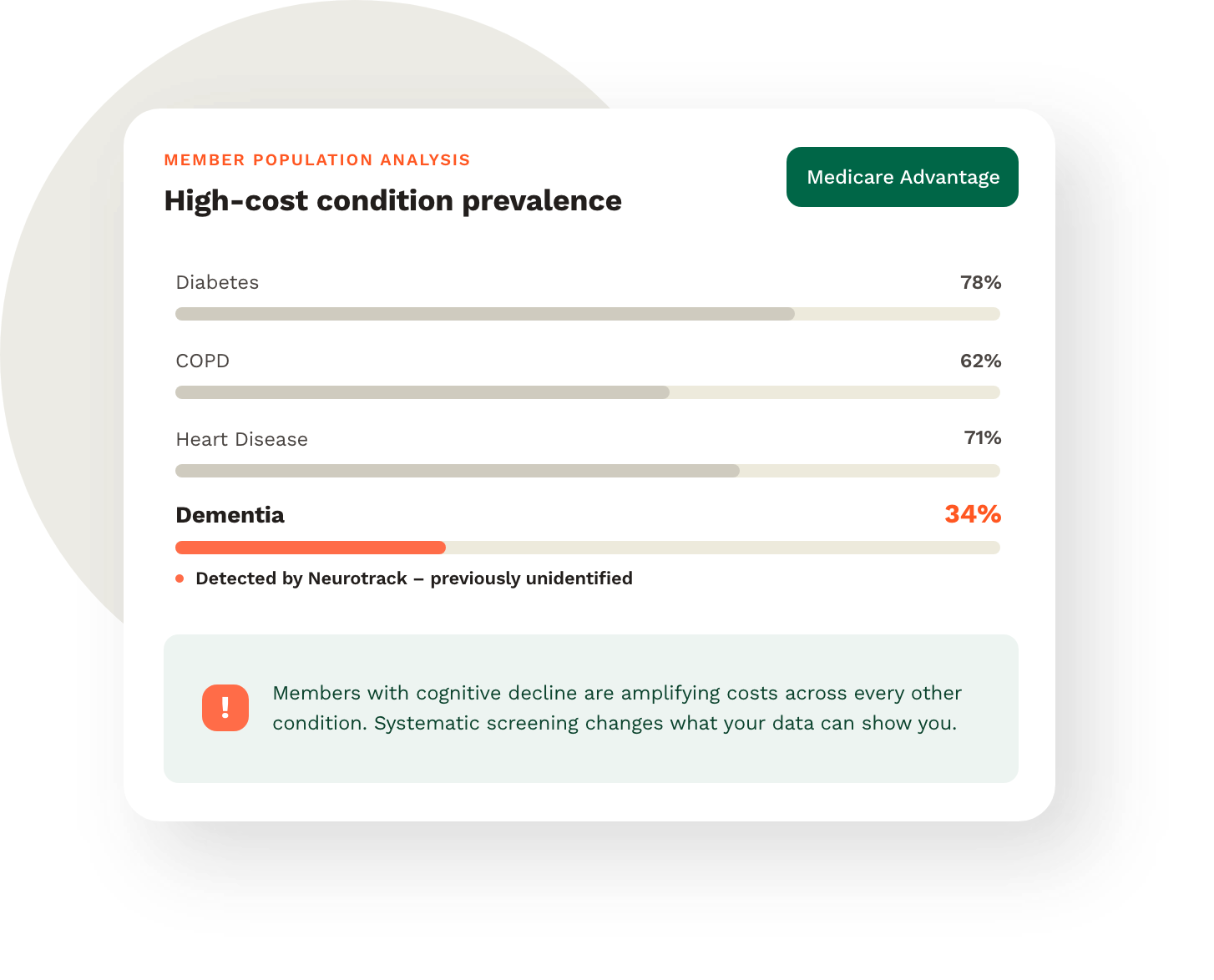
Most health plans prioritize allocated resources to managing their highest-cost conditions like diabetes, COPD, and heart disease. What many don’t yet account for is that undetected cognitive decline is compounding the cost of every one of those programs.


The members driving your highest utilization may not have a dementia diagnosis. But the data suggests many of them should.

Hidden cost of undetected cognitive decline

Undetected cognitive decline is already in your cost data. You just can’t see it yet.

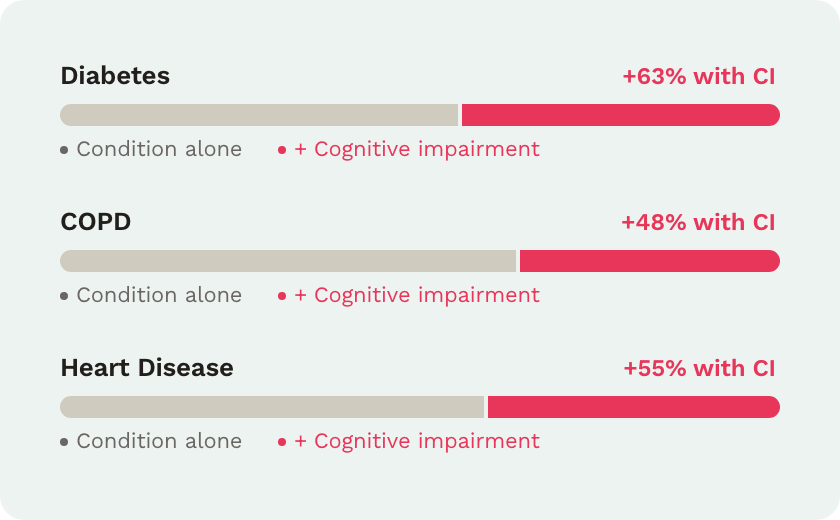
Undetected cognitive decline significantly increases the cost of managing other chronic conditions, including diabetes, COPD, and heart disease, independent of those conditions alone. Dementia doesn’t just add its own costs to a member’s care. It amplifies the cost of every chronic condition alongside it.

Incremental Healthcare Costs of Dementia and Cognitive Impairment in Community-Dwelling Older Adults, Journals of Gerontology, 2025.

Per-member cost amplification
img-cost-amplification-2
$44,814

Average annual cost per Medicare beneficiary with Alzheimer’s or other dementias

Earlier identification
changes this equation

$15,053

Average annual cost per Medicare beneficiary without Alzheimer’s or other dementias

Alzheimer’s Association, 2025 Alzheimer’s Disease Facts and Figures. Medicare costs in 2024 dollars.

The financial case for acting now

Cognitive care is no longer just a clinical imperative. It’s a financial one.

V28 is live

HCC risk adjustment

Dementia is now coded across three severity tiers, mild, moderate, and severe, and every level of specificity in a member’s cognitive record has a direct line to risk-adjusted revenue. Health plans that are systematically identifying cognitive decline in their member populations are capturing revenue others are missing.

icon-risk-adjusted

Accurate cognitive coding drives risk-adjusted revenue.

Neurotrack generates objective, clinically documented assessment results that support accurate V28 coding at the member level. Under V28, the severity of a member’s cognitive impairment directly determines their risk score and the plan’s reimbursement, making precise cognitive documentation a direct driver of risk-adjusted revenue. 

icon-expensive

Late-stage dementia is among the most expensive conditions a plan can carry.

Early detection leading to earlier intervention maintains members at lower severity levels longer, directly reducing the per-member cost trajectory over time.

Alzheimer’s Association, 2025 Alzheimer’s Disease Facts and Figures, Alzheimers Dement 2025;21(5). Medicare costs in 2024 dollars.
icon-growth

The cost of doing nothing is measurable and growing.

Medicare spent an estimated $164 billion in 2024 on Alzheimer’s disease and related dementias, with costs projected to exceed $1 trillion annually by 2030. Health plans not systematically identifying cognitive decline are absorbing those costs without the documentation or the ability to manage them.

Incremental Healthcare Costs of Dementia and Cognitive Impairment in Community-Dwelling Older Adults, Journals of Gerontology, 2025.

Where Neurotrack fits in your operating model

Three ways health plans are putting Neurotrack to work

Neurotrack is designed to integrate into the programs health plans already operate, not to create new ones. Whether through in-home health risk assessments, complex care management programs, or provider partnerships, Neurotrack surfaces the cognitive decline that existing programs are missing and connects members to a structured care pathway.

icon-home-assessment

In-home health risk assessments

Cognitive screening is an increasingly expected component of in-home health risk assessments for Medicare Advantage members. Neurotrack’s assessments are designed specifically for in-home administration, validated for accuracy outside clinical settings, and completable in minutes without burdening the member or the assessor. The result is a clinically rigorous cognitive assessment that fits naturally into existing HRA workflows and generates the documentation your plan needs for accurate risk adjustment.

icon-care-programs

Complex care management programs

Neurotrack enables care management teams to systematically identify cognitive decline in high-risk members and connect them to a structured clinical pathway before utilization escalates. Members with undetected cognitive decline are frequently the highest utilizers in these programs, often carrying multiple chronic conditions whose costs are amplified by a cognitive impairment that hasn’t been identified. 

icon-provider-partnership

Provider partnerships that help clinicians practice at the top of their license

Neurotrack gives in-network providers the clinically validated assessments and Smart Logic-powered care planning support they need to identify and act on cognitive decline earlier, generating the structured clinical documentation that flows back to the plan and supports accurate, ongoing risk adjustment. Health plans that equip their provider networks this way get better outcomes and more accurate documentation across their member population.

Proven in a Medicare Advantage population

Here’s what happened when a health plan put Neurotrack to work

A national Medicare Advantage plan deployed Neurotrack’s digital cognitive assessments within their home-based Annual Wellness Visit program, administered by trained nurse practitioners over a three month pilot period.

85% higher

MCI identification rate compared to traditional pen-and-paper assessment in this deployment

53% higher

Dementia identification rate compared to traditional pen-and-paper assessment in this deployment

All 50 states

The health plan integrated Neurotrack as a standard component of their national AWV program
icon-identify

Identifying cognitive decline at the MCI stage changes the cost trajectory for the member and the plan. Members identified earlier maintain lower severity levels longer, reducing utilization of emergency services, skilled nursing facilities, and high-cost transitions of care.

Incremental Healthcare Costs of Dementia and Cognitive Impairment in Community-Dwelling Older Adults, Journals of Gerontology, 2025.

See what systematic cognitive care identification can do for your member population

Join the health plans already taking a more proactive approach to cognitive care. Request a demo and find out how Neurotrack can fit into your operating model.

Request a Demo
Have questions first?
Talk to our team