
Two in three Americans living with Alzheimer’s are women, yet the disease still lacks the openness and routine detection that changed breast cancer care.
Every October, pink ribbons show up on storefronts, sports jerseys, and coffee cups. Breast cancer has become one of the most recognized health causes in the country, and that recognition took decades of work by patients, families, providers, and advocates. This month I keep thinking about another disease that falls hardest on women and still gets a fraction of that attention.
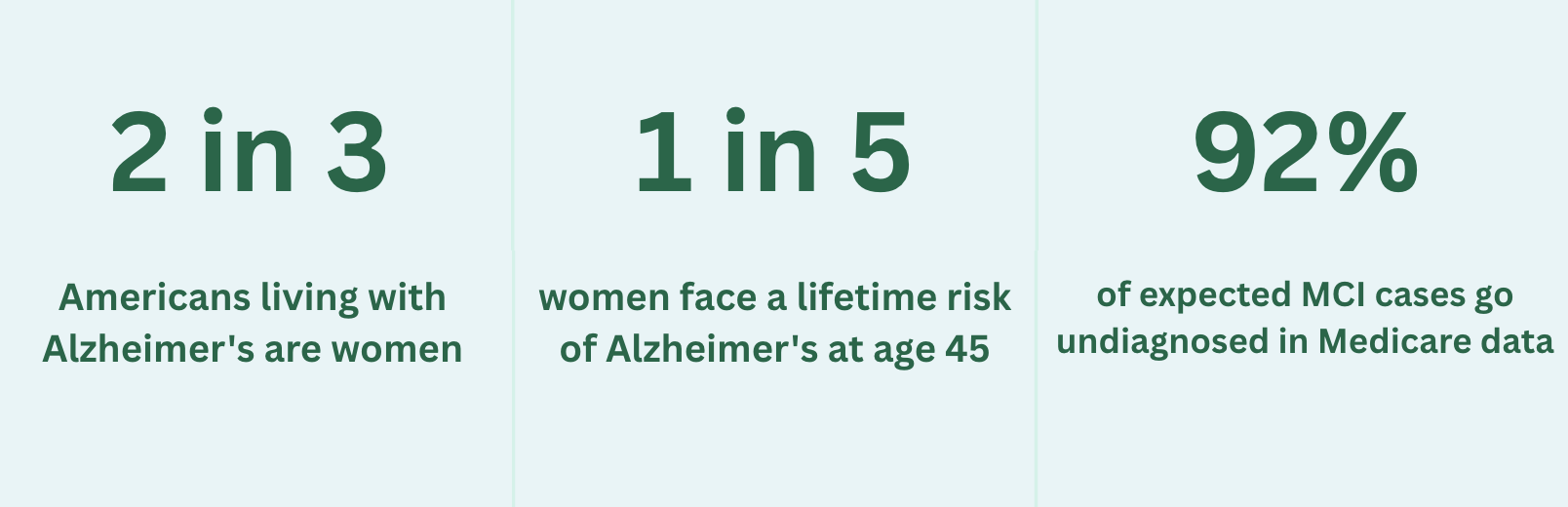
Almost two-thirds of Americans living with Alzheimer's disease are women, and more than 60% of dementia caregivers are women too. According to the Alzheimer's Association, a woman's lifetime risk of developing Alzheimer's at age 45 is 1 in 5. For breast cancer, the lifetime risk most women know by heart is about 1 in 8. An estimated 7.4 million Americans age 65 and older are living with Alzheimer's in 2026.
How breast cancer awareness changed early detection
It's easy to forget that breast cancer was once something people didn't say out loud. Women hid their diagnoses, and many didn't see a doctor until a tumor was impossible to ignore. That began to change when public figures like First Lady Betty Ford spoke openly about their diagnoses in the 1970s, and when National Breast Cancer Awareness Month launched in 1985 to promote mammography. Over time, a mammogram became something women scheduled as a normal part of staying healthy.
The American Cancer Society reports that breast cancer death rates have fallen 44% since 1989, averting roughly 517,900 deaths, and it credits both earlier detection and better treatment. Talking openly made women more willing to get checked, routine screening found disease earlier, and an earlier diagnosis gave treatment a better chance to work.
Why dementia diagnosis still comes too late
Dementia care today looks a lot like breast cancer care did before awareness campaigns took hold. Families notice changes and wait, often because they've been told, or tell themselves, that memory loss is a normal part of aging. Stigma keeps patients from raising concerns, and providers working through short primary care visits often don't have a simple way to assess cognition.
I know this from my own family. When my grandfather started showing signs of cognitive decline, we were told it was normal for his age, and it took years to get a formal diagnosis. At the time, there was little medicine could offer, so those years mostly cost us time to plan and prepare. Today the same delay would cost far more.
Our experience was common, and it still is. An analysis of Medicare data from 2015 to 2019 found that about 92% of expected cases of mild cognitive impairment (MCI) went undiagnosed, and a companion study found that more than 99% of primary care providers underdiagnosed MCI in their patients.
New treatments make early detection more urgent
Two FDA-approved treatments now slow the progression of early Alzheimer's disease, and both are indicated only for people with MCI or mild dementia. Someone diagnosed at a moderate stage has already missed the window when these medicines can help. Each year spent waiting for a diagnosis is also a year without the chance to address reversible causes of cognitive symptoms, such as medication side effects, thyroid problems, or vitamin B12 deficiency, and a year less to plan for the future with a clear picture of what's ahead.
|
Alzheimer's now has treatments and new diagnostic tools. What it still needs is the same openness and diagnostic routine that changed breast cancer care. |
Why routine cognitive assessment is dementia's mammogram moment
Mammography changed breast cancer care because it made detection routine. Women no longer had to wait until they found a lump, because a screening at a regular checkup could find disease before symptoms forced the question. Dementia needs the same shift, and the closest equivalent is routine cognitive assessment in primary care. A brief assessment at an annual visit can surface subtle changes well before a family starts to worry, and over time it can make checking cognition as ordinary as checking blood pressure.
When a mammogram shows something concerning, it triggers further investigation, usually a biopsy, to confirm what’s going on. A cognitive assessment works the same way. When it identifies signs of decline, it triggers a closer look, which may include a blood biomarker test, a PET scan, or other diagnostic workup to determine whether Alzheimer’s or other disease is the cause. Blood tests have made that step far more accessible: in 2025, the FDA cleared the first blood tests to aid in Alzheimer’s diagnosis, including Roche’s Elecsys pTau181, the first cleared for use in primary care. Like PET scans, these tests are intended for people who already show signs of cognitive decline, so routine cognitive assessment is what moves patients from a first concern to a diagnosis in weeks instead of years.
How cognitive assessment triggers further investigationIn breast cancer care, a mammogram that shows something concerning leads to a biopsy. In dementia care, a cognitive assessment that shows signs of decline leads to further investigation, such as a blood biomarker test or a PET scan, to confirm whether Alzheimer’s or other disease is the cause. |
How Neurotrack supports earlier dementia detection in primary care
This is the problem Neurotrack was built to solve. Our cognitive care enablement platform helps providers assess cognition during a routine visit, diagnose with confidence, and connect patients to the right care. Assessment fits into the workflows primary care teams already have, including the Medicare Annual Wellness Visit, which already calls for detection of cognitive impairment. When health systems make cognitive assessment a standard part of care, more patients get answers. Desert Oasis Healthcare saw a 35% increase in new dementia diagnoses after putting this approach in place.
Applying the lessons of breast cancer awareness to Alzheimer's disease
Breast cancer awareness succeeded because people started talking openly, screening became a normal part of care, and better treatments arrived alongside earlier detection. Alzheimer's now has treatments and new diagnostic tools, and what it still needs is openness and routine. This October, as we recognize how far breast cancer care has come, I hope providers and health systems will bring the same urgency to cognitive health, so that families who notice changes in someone they love get answers sooner.
44%drop in breast cancer death rates since 1989, credited to earlier detection and better treatment. Alzheimer's care can follow the same path. |
Elli Kaplan is Chief Executive Officer of Neurotrack. Neurotrack's Cognitive Care Enablement Platform provides digital tools for early cognitive detection, longitudinal monitoring, and care pathway activation, built to identify patients at the MCI stage when treatment options are greatest.
Ready to build the cognitive pillar of your diagnostic pathway?Neurotrack's Cognitive Care Enablement Platform gives health systems and Medicare Advantage plans the tools to detect cognitive decline at the MCI stage, document with clinical precision, and activate the care pathways that make a biomarker result actionable.
|