

A new Neurotrack white paper quantifies what many Medicare Advantage plans have long suspected: undiagnosed cognitive impairment is draining both care budgets and risk-adjusted revenue, at the same time, in the same members.
Somewhere in your member panel right now, there is a population that doesn’t appear in your claims data. These members are not flagged in your chronic condition programs, and they are not on a specialist's schedule. They are also very likely costing your plan more than you think.
That is the core finding of Neurotrack's new white paper, The Hidden Cost of Undetected Cognitive Decline. The research it draws on is worth paying attention to, because the math is more direct than most cost-of-inaction arguments in this industry, and because it changes how cognitive care should be prioritized within a plan's broader strategy.
Two Losses, One Undocumented Member
Undetected cognitive impairment is not a single cost problem for a plan. It is two, and they compound each other.
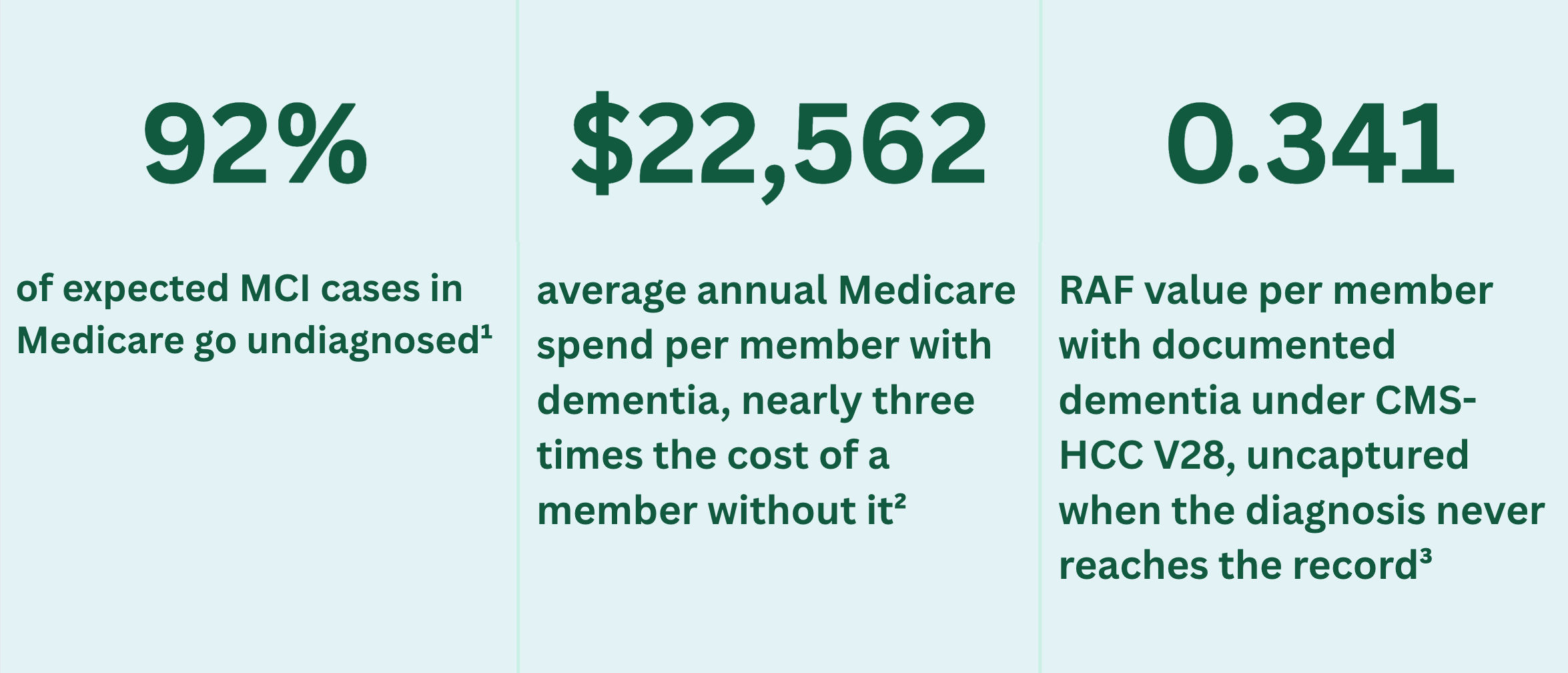
The first is utilization. Members with undiagnosed MCI or early dementia use more care in more expensive settings, including more inpatient admissions, more emergency visits, and more falls. Members who progress from MCI to dementia carry a cost premium of more than $10,000 a year over those whose cognition remains stable, and that trajectory accelerates the longer the condition goes unaddressed.
The second is revenue. Under CMS-HCC V28, dementia carries meaningful RAF weight across its three HCC categories. When a member's cognitive status is never diagnosed or documented, that value is never captured, and the plan is left managing a high-acuity member's costs while being paid at a lower-acuity rate. With an estimated 60% of dementia cases undocumented in primary care, this is not a rounding error. It is a structural shortfall built into every plan year.
|
The same member, with the same undiagnosed condition, costs the plan in two directions at once: excess claims on one side, uncaptured risk adjustment revenue on the other. |
The Comorbidity Multiplier
The white paper's most consequential finding may not be the direct cost of dementia. It is what undetected cognitive impairment does to every other chronic condition program a plan is already running.
Consider diabetes. Medicare members with both dementia and diabetes average $46,772 a year in medical costs, more than double the $21,140 for members managing diabetes alone.⁴ The pattern holds across the conditions plans invest most heavily in managing. An analysis of more than one million Medicare beneficiaries found that members with dementia represented 9.4% of the population but generated 22.8% of total healthcare costs.⁵
The mechanism is well understood. Chronic disease management depends on self-management, including medication adherence, glucose monitoring, inhaler technique, and appointment follow-through, and cognitive decline erodes that capacity long before a formal diagnosis exists. The result surfaces as an admission in the diabetes program or the COPD program, while the underlying cause remains invisible.
Until cognitive status is assessed at the population level, every disease management program in a plan's portfolio is operating with a blind spot that compounds year over year. That reframes cognitive assessment from a standalone initiative to infrastructure for the programs a plan has already funded.
This Is Not a Screening Problem. It Is a Reach Problem.
Annual Wellness Visits were intended to be the mechanism for catching cognitive decline early. In practice, they still miss the vast majority of cases, largely because traditional tools require a clinician to administer them within an already compressed visit, and because specialist waitlists of six months or more turn a positive finding into a long wait for care.
This is where Neurotrack's approach differs. The platform's self-administered assessments do not require a clinician in the room or a dedicated appointment, which means a plan is not limited to the members who happen to be screened during a PCP encounter. That is the difference between reaching the members who show up and reaching the members who need to be found.
The results are measurable. Desert Oasis Healthcare, a primary care medical group serving more than 60,000 members in Southern California, integrated Neurotrack's digital screening into routine wellness visits and increased dementia diagnosis rates by 29% in four months, with positive screens triggering warm handoffs to a dedicated dementia care clinic.⁶ Signify Health, the nation's largest provider of in-home health evaluations, uses Neurotrack's screening technology to reach members where they live, including rural markets that traditional screening infrastructure cannot serve.
A positive assessment does not stop at detection. It becomes documentation that supports accurate RAF coding, and a structured pathway that connects the member to care.
Putting the White Paper to Work
The math is straightforward even where the operational work is not. Earlier identification changes the cost trajectory and captures revenue that is currently being left on the table, and neither requires a plan to overhaul its provider network or recruit specialists it cannot find. It requires visibility into a population that is currently invisible, and a defined care pathway once that population is found.
That is the case the full paper makes, with the data behind every number above. For leaders building the internal case for cognitive assessment in the 2027 planning cycle, this is the resource to bring into that conversation.
Read the full white paper: The Hidden Cost of Undetected Cognitive Decline
References
- Alzheimer's Research & Therapy. (2023). Expected and diagnosed rates of mild cognitive impairment and dementia in the U.S. Medicare population.
- Alzheimer's Association. Facts and figures.
- Centers for Medicare & Medicaid Services. (2023). Announcement of Calendar Year 2024 Medicare Advantage Capitation Rates. CMS-HCC Model V28.
- Alzheimer's & Dementia / AAIC. (2024). Disaggregating medical costs due to dementia.
- AJMC. Impact of dementia on costs of modifiable comorbid conditions.
- Desert Oasis Healthcare / Neurotrack. (2025). Partner announcement.
|
Learn how Neurotrack's cognitive care enablement platform can support your program. Request a demo |